Returnable cash boxes for optimizing the cash supply chain “Logistics-on-Wheels”
The design and optimization of cash logistics are an essential part of Central Bank’s public mandate. The cash supply chain links the ordering of new banknotes (and coins) from printing plants (mints) - in accordance with the countries’ economic demand - with the storage and distribution of banknotes and coins to branches and ATMs, based on daily orders from commercial banks and savings banks. The banks regularly return their surplus currency volumes - at a minimum the banknotes unfit for circulation - back to the National Central Bank (NCB).
The NCB serves as the interface in the cash supply chain between the printing works and the commercial sector. It thus plays a decisive role in shaping the structure and efficiency of the cash eco system by defining rules and regulations governing how commercial banks must handle cash processing, including minimum volumes and frequency of orders and deliveries. An efficient cash logistics of NCBs is challenged by forecasting and buffering the large order volumes and limited order frequency with printing plants on one hand, and by the order fulfillment of the commercial sector which requires the delivery and deposit of small order volumes daily at the NCB's cash centers on the other hand. The engineering of the NCB’s cash center facilities with processing and storage must be adapted to meet the targeted capacities. At this point, the packaging of banknotes and coins is a crucial factor in optimizing the cash logistics and is regularly underestimated by NCBs and commercial banks in their efforts to optimize the cash cycle.
Over last decades, NCBs have focused primarily on banknote design and on banknote high-speed processing. As technology has advanced, optimization related to automated banknote processing systems have been developed by specialized vendors. However, process optimization in intralogistics at the cash center and external logistics along the cash supply chain remain to be neglected. This will become even more significant in developed economies where the volume of banknotes is declining and fixed costs per unit are rising, and in developing and emerging countries where the volume of banknotes continues to rise and the complexity involved in scaling up operations leads to space constraints in cash centers, rising error rates, and security risks.
Packaging stages for banknotes
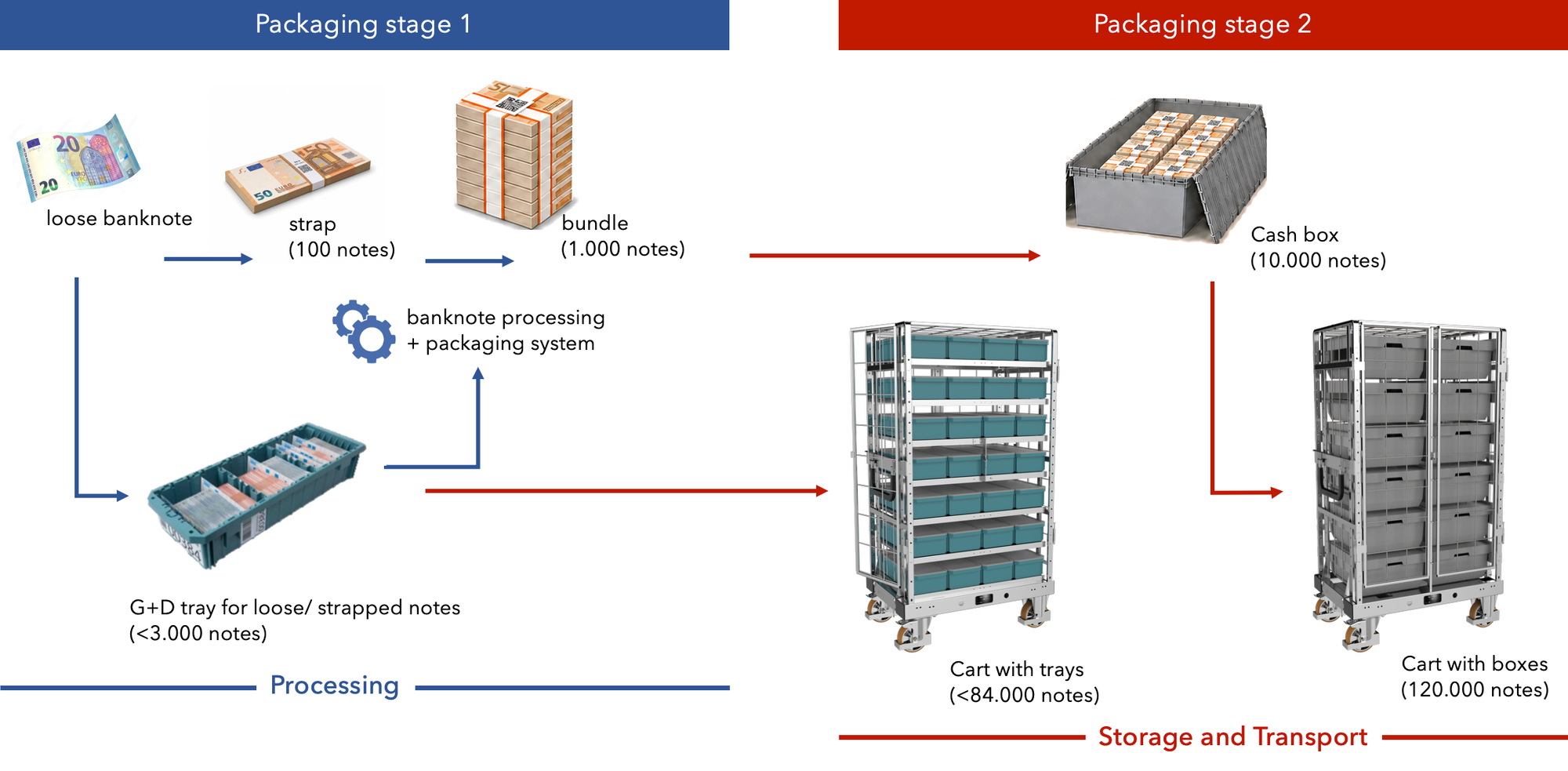
Ideal packaging units using boxes are based on the dimensions of a banknote. These are packaged in defined aggregation levels, usually in packets/ straps of 100 and 10 straps per bundle (1,000 banknotes). These packaging units are standard at printing works and at NCB level worldwide and are largely automated through banknote processing systems at packaging stage 1.
The next logical step towards further standardization in cash logistics is taking place at packaging level 2, which involves appropriate containers for storage and transport of banknotes. However, this objective is opposed by the conflicting interests among the parties involved in the cash cycle. Such situation leads to a complex variety of packaging types and sizes for storage and transport units within each cash ecosystem. While printing plants often optimize their packaging process by using single-use cardboard boxes in its sizes ranging from 10 to 50 bundles; many commercial banks use a wide variety of safebags, pouches, or boxes and containers, typically with a capacity ranging from 2 and 10 bundles. In addition, different ATM cassettes with the standard sizes of 2,000 to 2,500 banknotes are in use, as manufacturers also differentiate themselves through their ATM models and connected cassettes. Logistical perspectives that are elementary from the ground up in other industries are regularly not considered by the “professional cash handlers”.
Packaging stages for banknotes
Cash InfraPro’s assessments of cash centers at banks and cash-in-transit companies (CiT) have shown that these centers must manage no fewer than 15 to 40 different types and sizes of containers in their day-to-day operations. Each additional variant increases complexity costs disproportionately. It is therefore not surprising that CiT service providers consequently agree on the lowest common denominator, which is the safebag. This is a single-use product and an expensive approach in the long run; neither ecological sustainable nor in line with the requirements for process automation.
Optimizing the cash ecosystem using a returnable cash box
The Central Banks have the power to optimize the entire cash supply chain. They are the major intermediary and therefore play a key role in determining the efficiency of cash logistics by defining packaging units and delivery schedules. NCBs have generally an internal perspective to their processes, but it is necessary that they take a closer look at the cash logistics and considering the requirements of professional cash handlers for optimizing the cash cycle.
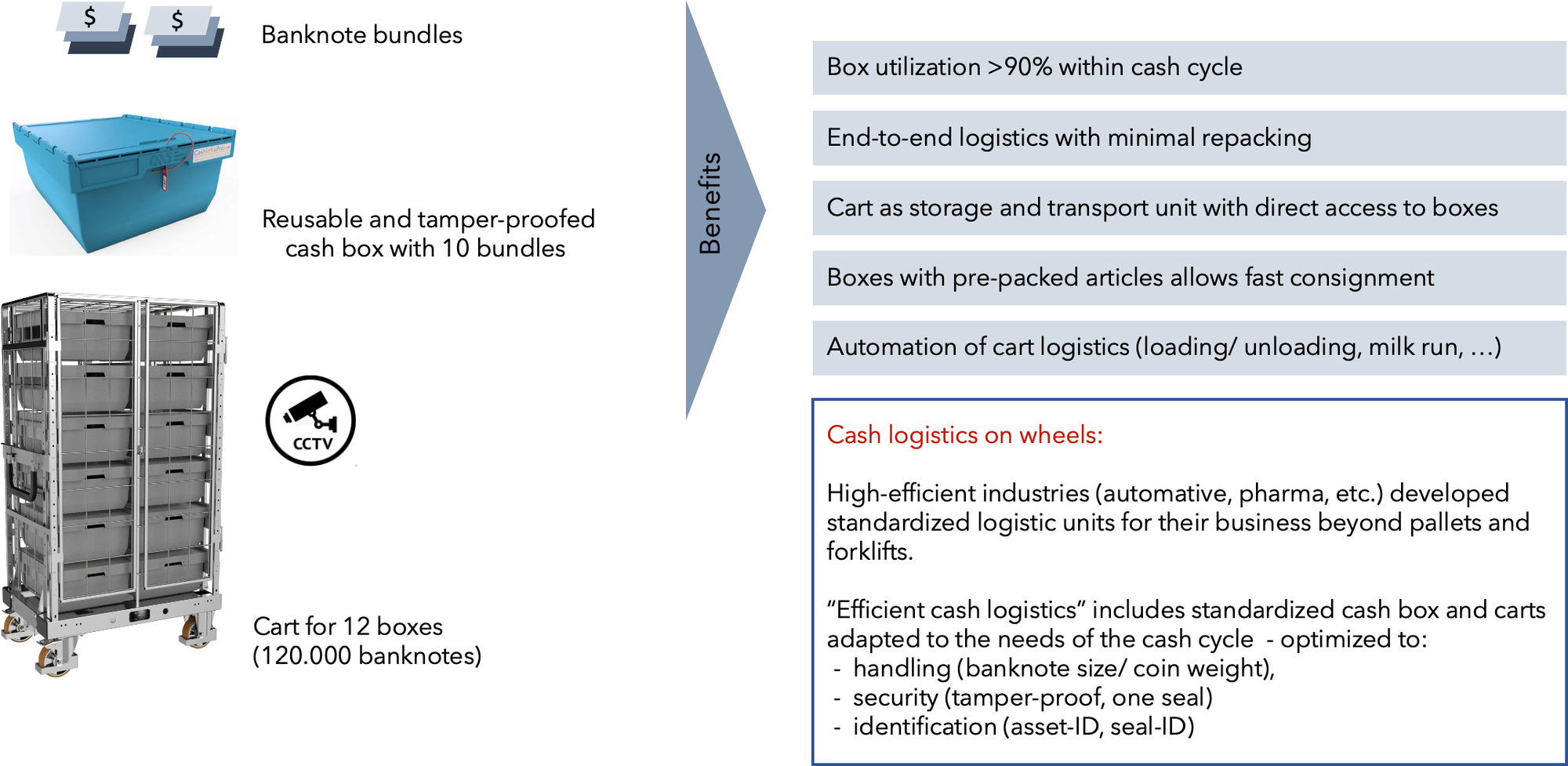
Generally, reusable and returnable containers must be the target of the optimization process. The returnable boxes circulate among professional cash handlers increasing efficiency and sustainability. Container pooling systems can be economically advantageous for NCBs, because they provide a closed-loop system in cash center networks with registered customers; and a cash box utilization rate of 90% or more can be achieved. This considers the environmental aspects of cash logistics as well.
The design and material selection for cash boxes should ensure a robust and dimensionally stable handling (with material of polypropylene in PP/HDPE), while also being stackable on top of one another and nestable inside one another. This function enables an optimization towards storage of empty boxes and the return of empty units to the printing works in terms of less transports. A benefit for countries or regions that have their own printing plant.
A well-thought-out choice of packaging must consider banknotes and bundles in stage 1, in stage 2 the cash box and transport cart must be designed in a modular design regarding handling, sizing, and security functions. This coordinated design principle enables scalability across all banknote aggregation levels along the cash supply chain - from the printing plant through the Central Bank to the end customer. This allows banknotes to be efficiently stored, picked, and transported with minimized repackaging.
This approach is reached using a standardized cash box, customized to hold 10 bundles across all common currencies, measuring 500 x 400 x 220 mm. The cash box with one security seal can be integrated into the cash cycle without the need for additional opening, content checks, or repackaging for a seamlessly transfer between professional cash handlers, if the integrity of the cash box and seal is verified. Reducing duplicate process steps leads to greater efficiency in handling during receiving and shipping, processing and storage. The special design of the cash box, featuring a locking and sealing system of the box cover with one seal prevents tampering, avoids damage during transport, and protects the units from environmental factors such as moisture or dust.
Optimized cash logistics with cash box and trolley concept
Logistics on wheels
Over the past decades, Central Banks have adopted a pallet-based logistics system optimized for bulk shipments. This system is well-suited for transporting banknotes and coins between production facilities and the Central Banks, but it requires repackaging at NCB’s cash centers on pallet as well as on box level. While the printing plant delivers mainly banknotes packed in cardboard or wooden boxes on a full pallet, containing at least 600,000 banknotes of a single denomination, the orders from banks for their branches typically consist of smaller units, often less than 10.000 banknotes per denomination.
An advanced logistics principle that is based on transport carts/ trolleys with integrated casters enable more flexible and faster handling processes in the cash center and facilitate transports between professional cash handlers. Trolleys equipped with 12 cash boxes and respective capacity of 120.000 banknotes, or alternatively, 28 cash trays with a capacity up to 84.000 notes have proven its effectiveness in cash logistics due to their size and design. They allow cash operators direct access to each individual cash box or cash tray of the trolley. This provided efficiency advantages in order picking at the cash center when comparing it to pallet logistics. Furthermore, the use of transport carts does not require any additional handling qualifications from employees; unlike the transport of pallets with forklifts, where a forklift operator’s license is mandatory. The design of trolleys - in terms of size and handling - requires less space for maneuvering in cash centers and vaults. This can be a particularly important factor in brownfield facilities where space is often limited.
The 4 mistakes to avoid in cash logistics:
1. The volume trap – procurement of too large containers
Universal and oversized containers are being selected that are not specifically adapted for banknote sizes and their packaging. The standard industrial containers are designed to fit on Euro pallets, with dimensions of 600 x 400 x 320 mm and higher, or half-boxes with dimensions of 400 x 300 x 200 mm. Both box sizes are not ideally suited for packaging of banknotes. On one hand, it shows a lower packing density, because the bundles do not match the inner box dimensions. On the other hand, the box sizes allow different packaging patterns depending on the banknote dimensions per denomination. This will ultimately increase the complexity due to the variety of configurations. In addition, the operator and CCTV surveillance has no direct view on the base layers when two or more layers of banknote bundles are packed into one box. Finally, packaging errors will increase.
The operators unconsciously overload larger containers up to the rim, loading the units with the maximum number of bundles. An industry container measuring 600 x 400 x 380mm can contain 20 bundles or more. The result is a box weight of 25 kg or more. However, a box weight over 15kg leads to additional handling requirements in manual operations to fulfill national health and safety regulations and international best practices. Workstations where such heavy containers are manually handled must be equipped with additional handling and lifting devices and/ or protective exoskeletons for the assigned employees. Strong recommendation: Prevent the situation where containers can be overloaded by employees; select from the beginning a cash box designed to hold a maximum of 10 banknote bundles. The cash box in size of 500 x 400 x 220mm is designed to accommodate the various currency denominations and qualities. It limits the contents to 10 bundles and the box weight to a maximum of 14 kg, allowing it to be used in both manual and automated operation without additional equipment.
2. Inconsistent packing patterns when containers are too large
The selection of a container with a height of more than 220mm allows the operators to pack the bundles into the “larger” container in multiple layers, and in various ways. This happens unambitiously since employees tend to streamline their work and to avoid empty space in the boxes, but these behaviors also lead to security and efficiency issues.
Ideally, banknote bundles should be packed in a consistent, uniform pattern within each cash box; for 10 bundles, this means 2 rows of 5 bundles in a single layer. Care must be taken to ensure that the banknote bundles are placed in the box with the label facing up. This enables an automated monitoring of operators’ activities via the CCTV camera surveillance, provided that the camera requires a scan of the loaded bundles with labels before the box lid is closed and sealed. If this information about the cash box plus the optical scan of the packaged banknote bundles with label is stored in the Warehouse Management System (WMS), this work principle allows an additional safeguard with alarm and proof in the WMS system against incorrect packaging of the box by the operator.
For larger and higher boxes which are unambitiously not packed in the correct mode and with multiple layers of bundles, this security principle cannot be checked like descripted above. A subsequent “full inspection” requires a complete unpacking of the respective box, which extends processing times at receiving and shipping area, and at order preparation stations.
3. “Blind handovers” at responsibility transfer points
At the receiving and shipping stations, operators are only scanning the box-ID barcode, without cross-checking it against the physical seal-ID. If the box has been opened without authorization, improperly sealed, or the seal was replaced, the tampering goes unnoticed until it reaches the destination. This can have negative consequences. The workflow in the WMS should therefore ensure that during each handover and inventory check, the box-ID and the seal-ID must be scanned both together (double-check).
These highlights another drawback of containers which are not design for the special purpose of security and currency industries. The usual industry containers are equipped always with two seal positions as standard, which both must be sealed and registered in the WMS to ensure tamper evidence. Then, during goods handover at receiving or shipping stations with involved pallet transport, all boxes stacked on the pallet must be depalletized to gain access to the rear seal.
4. Cash Center with pallet-logistics and forklift traffic in cash processing area
Cash centers designed for pallet and forklift logistics have an inherent disadvantage associated with safety risks towards higher accident rates in operational areas. Therefore, associated staff in cash centers and vaults must be specially trained and the operators must hold a forklift license. The use of forklifts also requires special protective anti-ram blockers at doors, walls, and racking systems in vaults, which increases the investment and maintenance costs for cash centers.
The pallet logistics requires additional handling efforts since the cash boxes must be repacked across different pallets in processes between receiving stations (boxes on pallets are sorted by routes) and the delivery of cash boxes to banknote processing stations (boxes must by sorted by customer or denomination). The same procedure applies between order picking and shipping of the pallets to its destination. After banknote processing, the banknotes are stored in the vault (sorted by denomination and banknote quality) and must be repacked into boxes for handovers to transport (sorted by customer orders).
Strong recommendation: Reduce the pallet handling with forklift traffic to the special receiving and shipping areas. Use the more flexible logistics-on-wheel system with suitable trolleys for cash processing area. Select adapted trolleys for intra-logistics, storage and transport that are robust and fits to respective dimensions and weight of cash box, cash trays and ATM cassettes. This logistics principle does not only reduce the risk of accidents and improves safety at work for employees and goods during cash handling; the design of the trolleys allows direct access to each individual cash box that results in significant efficiency gains in daily operations.
Future automation in cash centers and printing plants
In modern logistics, the interplay between automation and the size of the cash box is the decisive factor for efficiency, space utilization, speed and throughput, as well as flexibility in accessing the units by operators and/or robots. Current state-of-technology enables an efficient and flexible handling of smaller containers tailored to banknote size and packaging, as is the case with the cash box for 10 bundles in dimensions of 500 x 400 x 220 mm. Automation technologies that can be perfectly implemented for cash centers and printing plants enable high throughput of (smaller) cash boxes. The available technologies drive the engineering of automated vaults in storage and faster order fulfillment processes using appropriate WMS and handling systems such as automated storage and retrieval systems (ASRS)/ shuttles, trolley logistics, conveyor systems or autonomous mobile robots (AMR/AGV). All this contributes to improving the services level provided by NCBs and commercial banks’ cash centers. Central Banks can fulfill smaller order sizes from commercial banks faster and more flexible through implementing sufficient cash boxes and trolley logistics in combination with automation technology in their centers.
Source: Aedler/ ALS Logistic Solutions, Bito-Lagertechnik, Diebold Nixdorf, Giesecke & Devrient Currency Technology, Glory Global Solutions, K. Hartwall, NCR Atleos, Schoeller Allibert